

This review contains light spoilers.
Opening Hook
In the labyrinthine corridors of 'Gödel, Escher, Bach', Douglas Hofstadter's magnum opus, the reader is confronted with a perpetual puzzle: how to navigate the intricate web of concepts, ideas, and allusions that stretch across its 970 chunks. This is not a book about a subject; it is a subject in itself, a living, breathing entity that resists summary or categorization. As I delved into its depths, I found myself lost in the mirror maze of its structure, forever chasing reflections of reflections, and questioning the very nature of understanding itself.
What the Story Presents
At its core, the book presents a seemingly straightforward premise: an exploration of the intersection of computer science, artificial intelligence, and cognitive science through the lens of recursion and the Church-Turing Thesis. However, as the reader soon discovers, this text is not a straightforward exposition, but rather a rich tapestry of ideas, allusions, and anecdotes that weave together to form a complex, self-referential narrative.
What Stands Out
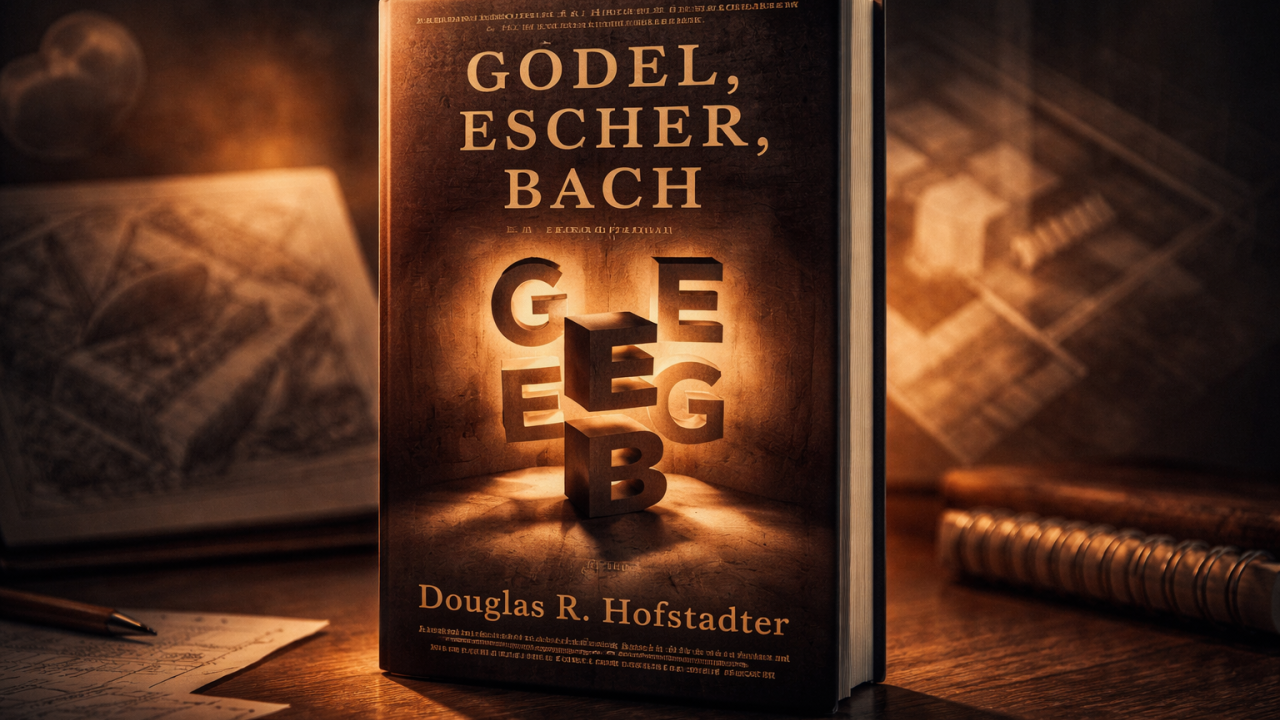
One of the most striking features of 'Gödel, Escher, Bach' is its deliberate mirroring of themes and ideas, as evident in the alternating structure of Parts GEB and EGB. This mirroring creates a sense of echoes and reverberations throughout the text, inviting the reader to ponder the relationships between seemingly disparate concepts. Additionally, the book's use of real-world examples, such as the SHRDLU natural language processing program, serves as a masterful demonstration of the power of abstraction and the importance of understanding complex processes in the brain.
Interpretation
Through its exploration of the Church-Turing Thesis and the limitations of formal systems, 'Gödel, Escher, Bach' raises fundamental questions about the nature of understanding and the limits of human knowledge. Hofstadter's interpretation of Gödel's proof as a mirror of the limitations of formal systems is a testament to the book's ability to transcend disciplinary boundaries and speak to the very heart of human inquiry. However, it is essential to note that this interpretation is the author's own, and readers may choose to disagree or propose alternative readings.
Why This Matters
In an age where complexity and specialization dominate the scientific landscape, 'Gödel, Escher, Bach' offers a much-needed corrective: a celebration of the beauty and power of interdisciplinary thought. By revealing the intricate relationships between seemingly disparate fields, Hofstadter reminds us that true understanding lies not in the reduction of complexity, but in the embracing of its multifaceted nature. As such, this book is not merely a treatise on computer science or cognitive science, but a testament to the enduring power of human curiosity and the boundless potential of the human mind.
Closing Line
As I closed the final chunk of 'Gödel, Escher, Bach', I was left with a sense of awe, not at the book's size or scope, but at its ability to encapsulate the very essence of human understanding: the recognition that our attempts to grasp reality are always tempered by the limitations of our own language, logic, and perception. In this sense, the book is not a destination, but a perpetual journey, a reminder that the search for knowledge is an endless, winding path that ultimately leads us back to ourselves.